White Papers
Domo Alternatives: Why Growing Companies Switch to GoodData
9 min read | Published

GoodData and Domo are both cloud analytics platforms, but they serve fundamentally different use cases. Domo is built for centralized internal BI with native ETL for a business-user-first experience. GoodData is an enterprise agentic analytics platform architected for embedded analytics, multi-tenant scaling, and AI agents grounded in a governed semantic layer.
If you are looking for a Domo alternative that supports embedded analytics, autonomous AI agents with governed metrics, or developer-led workflows, GoodData is worth a close look. If you need fast internal dashboards, Domo may still serve you better.
Key Takeaways
- Agentic AI: GoodData enables enterprises to build and deploy agents on top of a governed semantic layer. This helps ensure AI outputs stay aligned with business definitions, remain auditable, and are easier to trace. Domo has expanded its agentic capabilities through offerings such as Agent Catalyst, but its governance model is broader platform- and workflow-centric, rather than anchored in a native semantic layer comparable to GoodData’s metric layer.
- Multitenancy: GoodData supports workspace hierarchies and inheritance, allowing parent-level changes to roll out to child workspaces in a controlled way. Domo organizes access through accounts, pages, and sharing models, but operating large numbers of isolated customer environments is typically more manual than with a workspace-inheritance approach.
- ETL: Domo includes native data preparation through Magic ETL and a large connector ecosystem. GoodData expects a warehouse or curated upstream dataset, trading native ETL for greater flexibility in the analytics and semantic modeling layer.
- Embedding: GoodData supports iframe embedding, Web Components, and a React SDK for white-label, component-level integration. Domo Everywhere is primarily iframe-first, with JavaScript APIs and documented examples across JavaScript, .NET, PHP, and Python, but without a first-party React SDK or Web Components package comparable to GoodData’s component model.
- Pricing: GoodData's workspace-oriented pricing is transparent, making it easy to understand costs at any scale of external deployment. Domo’s consumption-based credit model can be harder to forecast as data movement, refreshes, and usage increase.
GoodData vs Domo at a Glance
When comparing Domo vs GoodData, the core differences come down to architecture, agentic AI capabilities, embedding, and how each platform scales.
Domo
Domo

Where Does Domo Work Well?
Domo is a capable platform for teams that need fast, centralized business intelligence. It is known for analytics but also seamlessly integrates data. As one of the more established solutions in the internal BI space, it earns its position for several good reasons:
- Magic ETL: Domo's drag-and-drop data preparation tool lets users combine different data sources without needing advanced programming skills. For more complex tasks, users can also create SQL data flows, similar to Magic ETL but in SQL format.
- Pre-built connectors: Domo offers a large connector ecosystem that makes it straightforward to connect common SaaS and operational data sources and quickly build a first dashboard.
- Business-user-first design: Domo offers an intuitive experience that doesn't require advanced programming skills, making it a practical choice for non-technical users.
- Integrated data movement Features such as Cloud AMplifier enable data integration directly inside the platform, without needing a separate data warehouse.
- Domo.AI: Domo has a legitimate AI layer for internal analytics, including an AI Service Layer for assisting with data flows, a Beast Mode AI Assistant for building metrics, and AutoML for machine learning and forecasting.
Where Does Domo Hit Its Limits?
Domo hits its limits when companies need to serve external clients, embed analytics into their own products, or manage the analytics change lifecycle the way they manage software. Within a single internal organization, Domo performs well, but architectural constraints make it a poor fit for companies growing beyond that, which is why companies typically begin to look for enterprise analytics alternatives to Domo.
1) Managing Analytics for Multiple Clients or Business Units
Domo’s sharing model is effective for internal hierarchies, but it is not the same as a parent-to-child workspace inheritance model. Teams managing many isolated customer environments often end up with more manual duplication, permission design, and repeated updates than they want.
The core problem is that if you copy a report in Domo and make changes, it affects the original report too. You may accidentally alter the original while editing the copy. There is no workspace inheritance, so every metric change must be manually replicated across each client environment. For a company managing analytics for more than around ten separate clients, this overhead quickly becomes unmanageable.
2) Building Analytics Into Your Own Product
Building analytics into your own product is where Domo's embedding limitations become most visible. Domo Everywhere does support white-labeling, so the final product can be branded to look like it was built by your company. However, customization is more limited than that of Domo competitors like GoodData. Interface-level overrides are constrained, and more advanced visualizations require the Domo App Store.
On the developer side, Domo offers IFrames and the Domo SDK, but SDK support covers Java and Python only. There is no React SDK and no Web Components option, which is a meaningful constraint for front-end engineering teams building analytics into a modern product stack. This limits how deeply analytics can be integrated at the component level.
3) Scaling With Engineering and DevOps Workflows
Domo does not support the version control, CI/CD pipelines, or analytics-as-code workflows that engineering teams rely on. Teams working with git and version-controlled deployments will hit a hard wall. There is no git-based versioning for analytical content, no rollback, and no code review process for dashboards or metrics.
What does this mean in practice? For teams beyond a handful of developers managing shared metrics, a governance bottleneck forms that becomes more acute as the team scales. For engineering-led organizations, this is one of the main differences between Domo and its competitors — and could be a reason to choose an alternative solution.
Why Do Companies Choose GoodData as an Alternative to Domo?
Companies choose GoodData because it directly solves the architectural problems that cause companies to outgrow Domo. GoodData prioritizes enterprise-agentic analytics built on governed definitions. It provides:
- Stronger isolation and inheritance patterns for many external tenants.
- Deeper programmatic embedding for product teams.
- Metadata lifecycle workflows that resemble software delivery.
GoodData also offers an intuitive interface, self-service analytics, and embedded analytics, with low-code/no-code options for business analysts alongside developer-friendly features like an API-first approach and analytics as code via its VS Code extension.
The Semantic Layer as the Foundation for AI-Ready Analytics
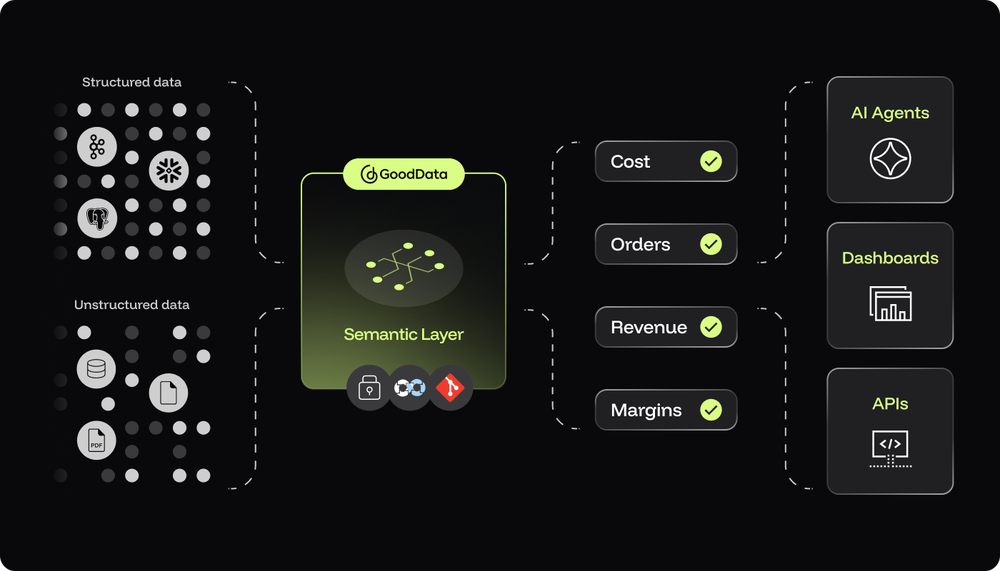
GoodData's semantic layer is the foundation that makes AI-ready analytics possible, and it is what separates GoodData from Domo as an agentic platform.
GoodData’s semantic layer sits between the raw data model and the tools that consume it (dashboards, AI agents, APIs, and external applications), translating raw data structures into consistent business definitions. This ensures terms like "revenue" or "conversion" mean the same thing across every team and every consumer, before any AI touches the data.
When an LLM queries your data through GoodData, it receives structured business context rather than raw SQL, with no custom prompt engineering required per dataset.
GoodData's Agent Builder and MCP Server extend this further, enabling AI agents to interact with your data through the semantic layer programmatically, while bringing the customer’s own context. Context Management acts as the trust layer on top: it governs the conditions under which AI outputs remain valid and auditable in production. Companies will find that Domo.AI has no equivalent governance foundation.
AI Features: GoodData vs Domo
Both GoodData and Domo offer AI capabilities, but they serve different audiences. The table below shows how the key capabilities compare.
Domo
Domo
GoodData’s Multi-Tenant Workspace Inheritance
GoodData's workspace inheritance model solves the multi-tenant problem that Domo cannot. It uses multitenancy with workspace hierarchies, where a parent workspace contains the master layer of metrics, dashboards, and governance rules. Every child workspace inherits changes made at the parent level automatically, with separate domains, permission levels, and data isolation per tenant. This is what makes GoodData a viable enterprise analytics alternative to Domo for companies serving dozens or hundreds of separate clients.
Domo
Domo
White-Labeled Embedded Analytics
GoodData has a clear competitive edge over Domo when it comes to embedding analytics and customization. Customers can programmatically manage everything to visually tailor analytics, ensuring seamless integration and a unified product experience. This is one of the reasons companies choose GoodData when evaluating the best tools similar to Domo.
GoodData offers three embedding methods: IFrame (simplest), Web Components (component-level), and React SDK (full programmatic control). All three support complete white-labeling with no GoodData branding visible to end users, and there is the option to create custom visualizations and alter the overall application appearance.
Domo
Domo
GoodData has a clear competitive edge when it comes to embedding analytics, and the experience of Atheer illustrates why. Atheer is a frontline operations platform that needed to give its customers real-time visibility into task completion rates, workforce productivity, and compliance. By embedding GoodData analytics directly into its product, Atheer delivers those insights fully under its own brand. The result: measurable customer impact in under 90 days, and a deployment that now spans over 20 GoodData workspaces.
Pricing Comparison
Domo and GoodData use different pricing models. Domo's consumption-based approach can be unpredictable, whereas GoodData offers transparent pricing suitable for various company sizes; one reason it ranks highly when comparing Domo alternatives for scalable deployments.
Domo users buy credits to cover data storage, ETL pipeline management, and visualizations. Full platform access is available to everyone if enough credits have been purchased, and DomoStats offers usage tracking. It is difficult to forecast how much you will use the platform in the future, or how many users you might have. Domo's pricing requires a sales conversation to get a quote.
GoodData provides various pricing tiers to fit a company's budget, with transparency and predictability built in:
- Internal use cases: GoodData charges based on user adoption within a company.
- External use cases: GoodData uses a per-workspace pricing model, assigning one workspace per vendor, partner, or client. This guarantees predictable pricing based on workspace count, with flexible user access organized into groups. It is well-suited for B2B analytics products.
Example: For a company with 50 B2B clients and 500 end users, GoodData charges for 50 workspace licenses regardless of user count. Adding new tenants (as a workspace) is straightforward — as is managing security and content.
Who Should Choose GoodData and Who Should Stick With Domo?
If you are looking for an analytics platform similar to Domo but built for external-facing products and enterprise scale, GoodData is certainly worth considering. Here is how to decide which of the two solutions is right for you.
Choose GoodData if:
- You’re delivering intuitive self-service analytics with the support of agentic AI capabilities.
- You are building analytics as part of your own SaaS product delivered to external customers.
- You manage analytics for dozens or hundreds of separate client environments and need centralized governance.
- Your engineering team works with git and CI/CD and needs version control over metrics and dashboards.
- You need full white-label and programmatic embedding with no visible third-party branding.
- You are deploying AI agents over your data and need a consistent semantic layer as the foundation.
Stick with Domo if:
- You need to stand up internal BI quickly without a dedicated data warehouse or data engineering team.
- Your team is primarily non-technical and requires drag-and-drop ETL with a low learning curve.
- You do not need white-label embedding or multi-tenant client isolation.
Get Started With GoodData
Still hesitating between GoodData and Domo? Request a personalized demo for a platform walkthrough.
See How GoodData Compares to Other Domo Competitors
GoodData is one of several Domo alternatives and competitors that you may wish to evaluate. If you are comparing GoodData against the other platforms, these guides cover the key differences:
- AWS QuickSight Alternative
- Sisense Alternative
- Tableau Alternative
- Qlik Alternative
- Looker Alternative
- Power BI Alternative
Note: The evaluation of features above is based on publicly available information at the time of writing. Readers are encouraged to conduct their own research. All product names, logos, and brands are used for identification purposes only and remain the property of their respective owners.
Frequently Asked Questions About Domo Alternatives
GoodData is one of the most capable Domo competitors for companies that need embedded analytics, multi-tenant architecture, or developer-friendly deployments. For internal BI with minimal data infrastructure, Domo may still be the simpler choice.
The main differences between Domo and GoodData come down to four areas: agentic capabilities, architecture, embedding, and pricing. GoodData is an agentic platform built for multi-tenant embedded analytics with a native semantic layer; Domo is built for centralized internal BI with native ETL. GoodData supports full white-label embedding; Domo's options are more limited. GoodData pricing is per-workspace and predictable; Domo uses consumption-based credits that are harder to forecast.
Yes, for external-facing products. GoodData supports full white-label embedding via IFrame, Web Components, and React SDK, with complete appearance override and no visible third-party branding. Domo Everywhere offers embedding, but white-label options are limited and Domo branding remains visible.
Companies looking for Domo AI alternatives will find that GoodData AI is built on top of a governed semantic layer and context layer. AI agents receive business-defined context rather than raw SQL, making outputs consistent and auditable. Domo.AI lacks a structured semantic foundation, making AI outputs harder to govern and reconcile across teams.
Yes, alternatives to Domo software include solutions like GoodData, which uses workspace-based pricing that scales predictably with client count. Domo's consumption-based model means costs grow with data operations (storage, ETL, and visualizations), making cost forecasting difficult as usage scales. GoodData's per-workspace pricing remains predictable regardless of how many end-users access each workspace.
Trusted by







Does GoodData look like the better fit?
Get a demo now and see for yourself. It’s commitment-free.