Agentic Data Plane, Control Plane, Serving Plane: Why So Many Planes?
7 min read | Published


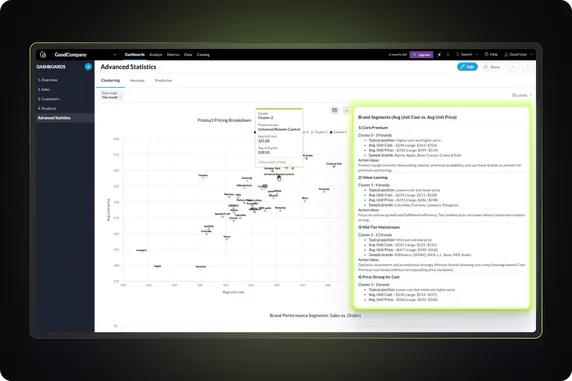
AI agent infrastructure is splitting into three distinct layers, each with a new "plane" to explain. The agentic data plane connects agents to raw enterprise data in real time. The agentic control plane governs their identity, permissions, and behavior across frameworks. The agentic serving plane fills the remaining gap: one governed layer that gives every dashboard, application, assistant, and agent the same business semantics, the same permissions, and the performance agent workloads need.
Key Takeaways
- An agentic data plane (the term Redpanda uses) moves and connects enterprise data to AI agents in real time, typically through streaming and Iceberg-based query engines.
- An agentic control plane (the framing used by Snowflake, Microsoft, and AWS) governs agent identity, permissions, and lifecycle across different agent frameworks.
- An agentic serving plane adds what neither layer provides on its own: shared business semantics, governed metrics, and predictable performance and cost for agent workloads.
- Gartner predicts that by 2030, universal semantic layers will be treated as critical infrastructure, alongside data platforms and cybersecurity. It also predicts that by 2030, half of AI agent deployment failures will be due to insufficient AI governance platform runtime enforcement and multisystem interoperability.
- These three layers are complementary, not competing. Most enterprises will end up running capabilities from all three, whether from one vendor or several.
Why three new "planes" appeared at once
Enterprise data infrastructure was built for people, not software. Humans ask occasional questions through dashboards, operate at modest concurrency, and get access through broad, durable roles. AI agents break all three assumptions. They query continuously, turn a single task into dozens of parallel calls, and need permissions scoped to the task rather than a broad role.
That shift is forcing vendors to borrow a decades-old idea from networking and distributed systems: separating the control plane (how work is configured and governed) from the data plane (where the work actually happens). Applied to AI agents, that split explains why two new categories, the agentic data plane and the agentic control plane, emerged within months of each other in late 2025 and 2026.
A third category, the agentic serving plane, has emerged alongside them for a different reason. Connecting agents to data and governing their identity addresses access and authority. But neither answers the business questions: What does "revenue" include? Which join path is safe? Can an agent's answer be traced back to a definition someone can check?
What is an agentic data plane?
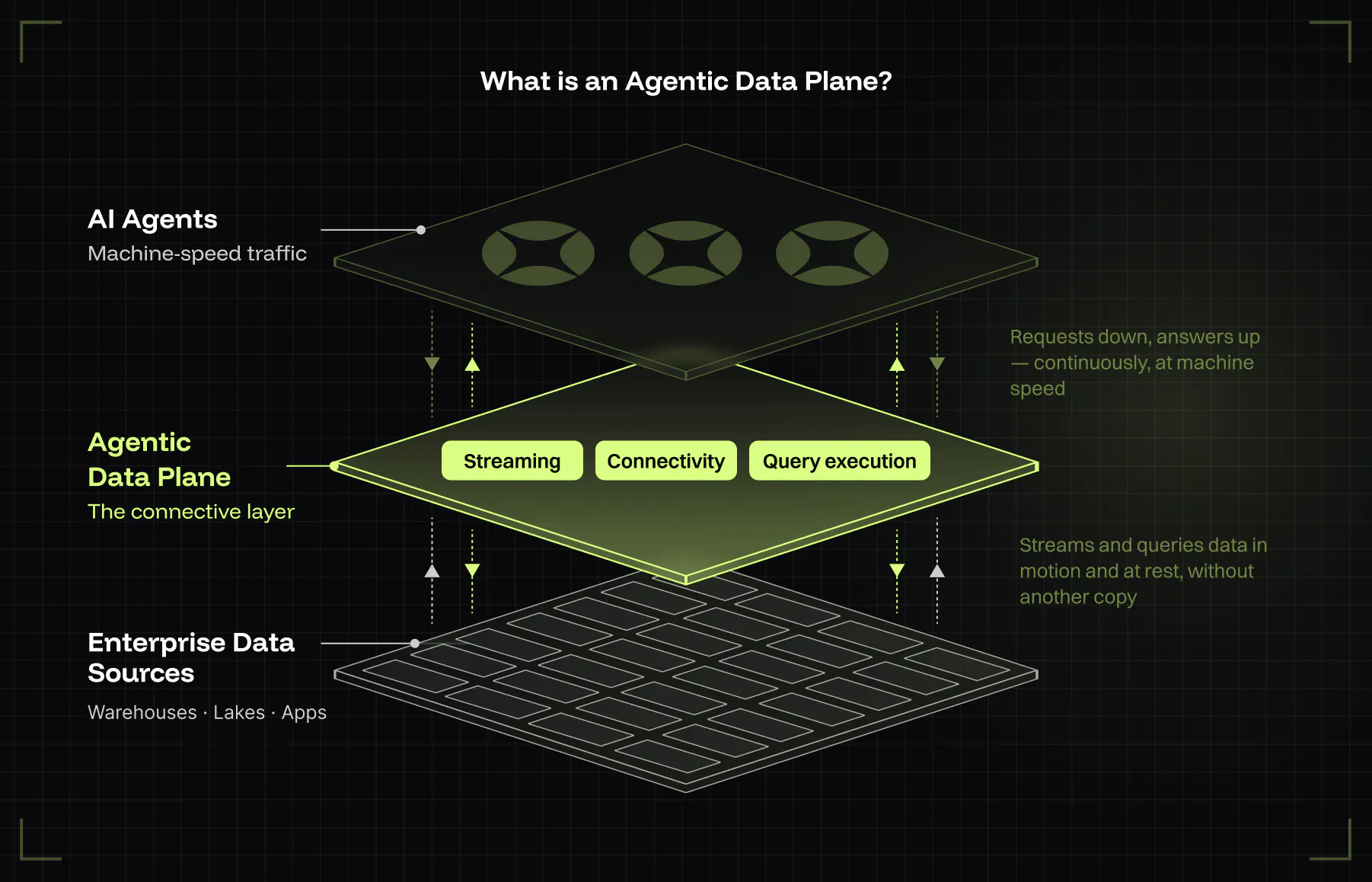
An agentic data plane is the infrastructure layer that connects AI agents to enterprise data sources in real time, handling the streaming, connectivity, and query execution that machine-speed agent traffic requires.
Who is building the agentic data plane?
Redpanda introduced its Agentic Data Plane in October 2025, alongside its acquisition of Oxla, a distributed SQL engine built for Iceberg queries. Redpanda describes the offering as a unified runtime that combines a low-latency streaming layer, an Iceberg-native query engine, the Redpanda Connect data connectivity suite, and a managed policy and audit layer for agent access.
What an agentic data plane solves, and what it doesn't
An agentic data plane solves connectivity: getting agents reliable, low-latency, governed access to data that lives across warehouses, lakes, and operational systems without forcing a new copy of that data. It does not solve what the data means. A data plane can hand an agent a table called orders; it cannot tell the agent whether "revenue" should include tax, refunds, or both, and that gap is exactly where agents start returning inconsistent answers.
What is an agentic control plane?
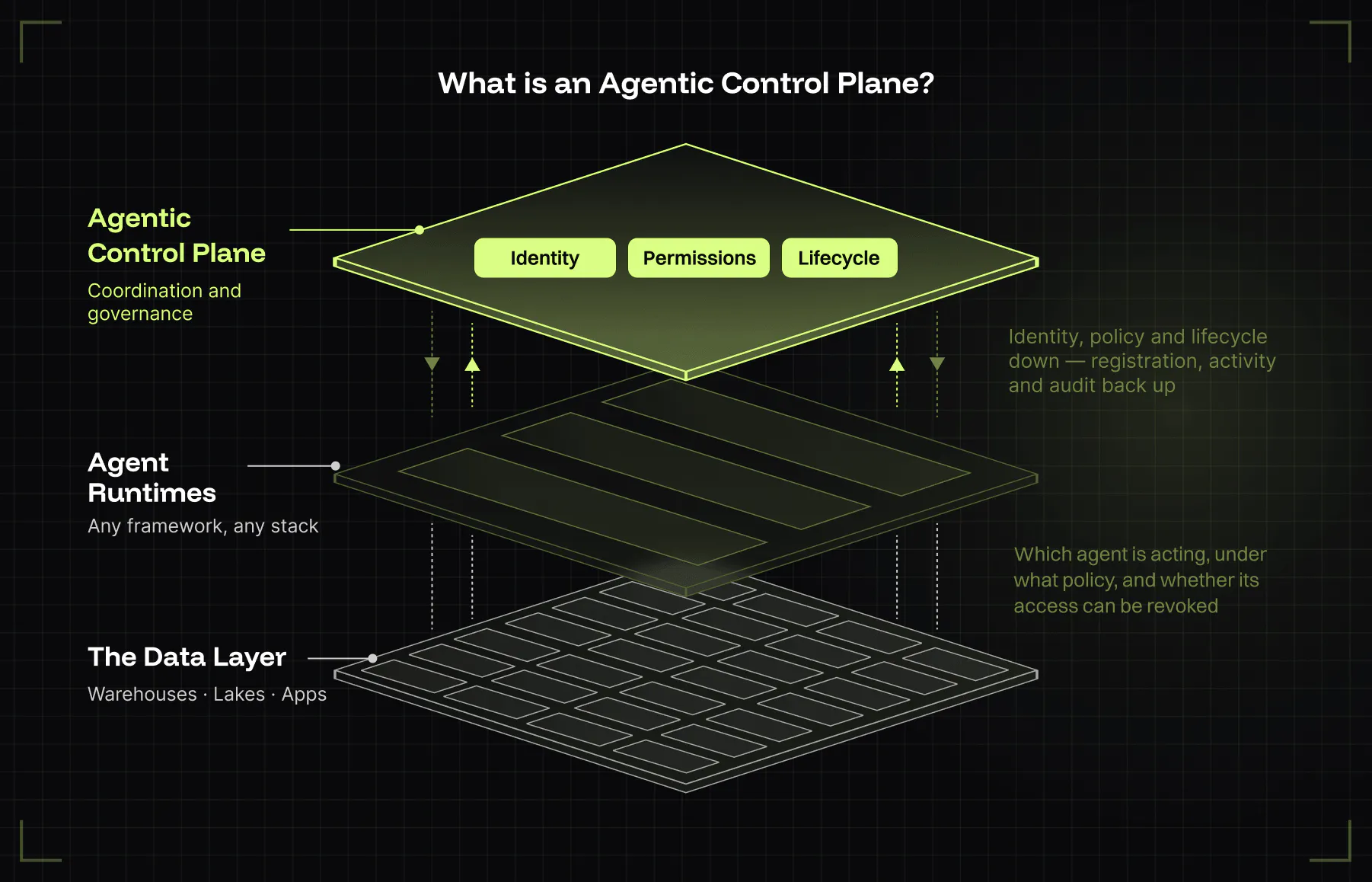
An agentic control plane is a coordination and governance layer that manages AI agent identity, permissions, and lifecycle across different agent frameworks and runtimes. It decides what an agent is allowed to do, not what the data it reaches actually means.
Who is building the agentic control plane?
The term has multiple backers. Microsoft positions Agent 365 as a control plane to observe, govern, and secure AI agents across Microsoft and partner ecosystems. AWS covers the pattern in its prescriptive guidance on employing control planes in agentic environments, where the control plane handles agent configuration, observability, metering, and tenant policies.
Snowflake has staked out the most explicit public position. In a March 2026 post, CEO Sridhar Ramaswamy called the control plane "the missing layer" for the agentic enterprise, the coordination and governance layer that "translates intelligence into authorized enterprise action." He then made the agentic control plane the center of his Snowflake Summit 2026 keynote in June.
What an agentic control plane solves, and what it doesn't
An agentic control plane solves identity and authority: which agent is acting, under what policy, with what permissions, and whether those permissions can be revoked instantly. The stakes are real: Gartner predicts that by 2030, 50% of AI agent deployment failures will be due to insufficient AI governance platform runtime enforcement for capabilities and multisystem interoperability.
What a control plane does not solve is how an agent interprets the data it is authorized to see. Two agents with identical permissions can still compute "net revenue last quarter" two different ways, because permission and definition are separate problems.
What is an agentic serving plane?
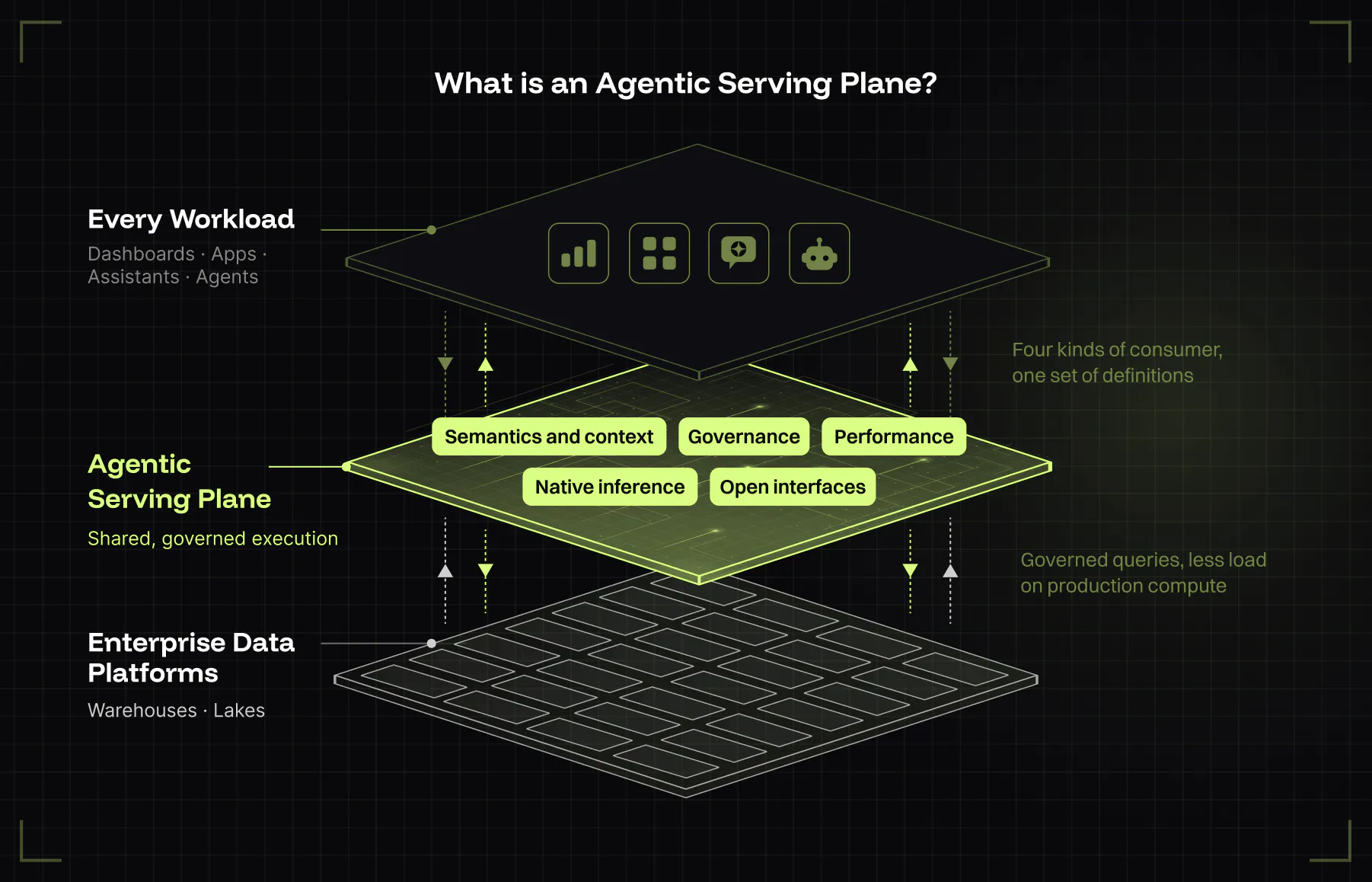
An agentic serving plane is a governed execution layer between enterprise data platforms and the dashboards, applications, assistants, and agents that consume them. Each consumer works from the same governed definitions rather than reinventing them, and the layer is built for the continuous, high-concurrency demand that traditional data platforms were never designed to serve.
Connectivity and identity matter, but they are not enough to make agent answers trustworthy. A serving plane brings together five capabilities that neither a data plane nor a control plane provides on its own.
The five capabilities of an agentic serving plane
- Semantics and context: define business meaning once, use it everywhere. Metrics, entities, and relationships are defined once, so a dashboard, an application, and an agent that all ask about "revenue" get the same number. Every answer can be traced back to the definition behind it, and definitions live as versioned code, because one edited metric can change thousands of automated answers overnight.
- Governance: control what people and agents can access and do. Permissions apply to every request, down to the field and row level, under the identity of the user an agent acts for, rather than through broad roles or trusted-application status.
- Native inference: use the right model for each workload, inside your boundary. Teams can bring their own LLM provider or keep inference local, so sensitive data does not have to leave their environment to be analyzed.
- Performance: serve agentic demand at predictable latency and cost. Caching, pre-aggregation, and per-tenant data marts absorb bursty agent traffic, so one agent task that fans out into dozens of queries does not run up the warehouse bill.
- Open interfaces: connect through SQL, MCP, A2A, and SDKs. Any agent framework or application calls the same governed layer, so the serving plane works with the control plane and agent runtime an enterprise already has.
Why semantics is the missing piece
Most agent failures on business data are not access failures. When an agent works directly with raw tables, it has to guess what "revenue" includes, which join is safe, and who may see the result. Those guesses change from one answer to the next. A semantic layer fixes this by defining metrics, entities, and permissions once. Agents then use governed definitions instead of creating their own logic against raw data.
Gartner frames the same conclusion as an infrastructure decision: in its 2026 predictions for data and analytics, it expects that by 2030 universal semantic layers will be treated as critical infrastructure, alongside data platforms and cybersecurity. Our guide to the semantic layer for AI agents covers what agents need from that layer in detail.
Side by side: how the three planes compare
| Dimension | Agentic data plane | Agentic control plane | Agentic serving plane |
|---|---|---|---|
| Primary question answered | How do agents reach the data? | What is this agent allowed to do, right now? | What does this data mean, and can the answer be trusted? |
| Core technology | Streaming, Iceberg-native query engines, connectors | Identity, policy engines, agent lifecycle management | Semantic models, governed metrics, MCP, caching |
| What breaks without it | Agents can't reach the data they need in time | Agents operate with no accountability or revocable authority | Every tool returns a different number for the same question |
| Primary stakeholder | Data and platform engineering | Enterprise IT, security, and AI platform leaders | CDOs, data leaders, and analytics teams |
| Examples (as of 2026) | Redpanda Agentic Data Plane | Snowflake, Microsoft Agent 365, AWS guidance | GoodData.AI Agentic Serving Plane |
These layers are complementary, not competing
The three layers complement one another, but that does not mean you need to buy three separate products. Vendors package these layers differently: some offer a layer as a standalone product, while others build it into a broader platform. GoodData.AI's Agentic Serving Plane is the architecture of the GoodData.AI platform, not a separate product you buy. In practice, most enterprises won't assemble three independent purchases. They will look for a platform, or a combination of platforms, that covers all three areas without connecting data access, governance, and semantics by hand.
Which layer does your organization need first?
- Prioritize data-plane capabilities if AI agents can't reliably reach data scattered across warehouses, lakes, and operational systems in real time, and connectivity itself is the bottleneck.
- Prioritize control-plane capabilities if agent sprawl across multiple frameworks has already created a security or compliance problem: nobody can say which agent touched what, or revoke access quickly when something goes wrong.
- Prioritize serving-plane capabilities if the same business question already returns different numbers depending on which dashboard, application, or assistant answers it, because that is a semantics problem, not an access problem.
Most enterprises that run agents at scale will need capabilities from all three. Starting with the layer that matches your current failure mode avoids over-engineering governance before you have agents running, or adding agents before you can trust what they report.
How GoodData.AI approaches the Agentic Serving Plane
GoodData.AI puts analytics, AI, and agents on one data serving plane: one trusted definition behind every number, running where your data has to stay. The Agentic Serving Plane is the architecture behind that, and it maps to concrete platform capabilities:
- Semantic model and Analytics Catalog: certified metrics, attributes, and relationships defined once. A Semantic Quality Agent flags unclear or duplicate names, and AI Memory and AI Knowledge ground AI in each workspace's business terms.
- Context Management: approved knowledge, agent instructions, and access rules carried across every AI experience, from dashboards to autonomous agents.
- One permission model for BI and AI: object-, column-, and row-level permissions, with every request from the UI, APIs, AI Assistant, or the MCP Server running under the authenticated user's permissions.
- Model choice: bring your own LLM provider through AI Hub, or use local inference on GoodData-hosted GPUs with no third-party model provider in the data path.
- Performance under agent load: caching with validity periods, pre-aggregation, and tenant data marts built from open Iceberg tables keep agent traffic off production warehouse compute.
- MCP Server and open interfaces: governed access over MCP, A2A, SQL, and SDKs, so GoodData.AI coexists with the agent framework an enterprise already runs. How we built the MCP Server explains the design.
- Multitenancy: each tenant's data, permissions, and business context stay isolated for agents embedded in customer-facing products.
- AI Observability: see how AI is used across workspaces and where it fails or times out, and open any answer to follow the steps behind it.
These capabilities sit on top of a customer's existing data environment rather than replacing it. Built on Apache Iceberg and Apache Arrow, GoodData.AI serves workloads from customer-controlled data in place, and it runs in your cloud, on-premises, or air-gapped.
Where to go from here
If the same business question already returns different numbers depending on which dashboard, application, or AI agent answers it, that points to a missing serving plane, not a missing data plane or control plane. Request a GoodData.AI demo to see how a governed semantic model, the MCP Server, and per-request permissions work together on your own data.
An agentic data plane connects AI agents to enterprise data in real time, handling streaming and query execution. An agentic control plane governs agent identity, permissions, and lifecycle, independent of which data an agent touches. One answers "can the agent reach the data," the other answers "is the agent allowed to act."
A semantic layer is the core component of an agentic serving plane, but the two aren't identical. A serving plane combines semantics and context with governance, model choice, performance for agent workloads, and open interfaces, and serves all of that to dashboards, applications, and agents from one governed execution layer.
GoodData.AI's Agentic Serving Plane enforces permissions at the data and semantic layer, down to the field and row level. It decides what the user an agent acts for may see and compute, using governed metrics and metadata. A control plane operates at a broader layer, coordinating agent identity, policy, and lifecycle across many applications and models. The two are designed to work together: a control plane governs which agent is allowed to run, while GoodData.AI governs what that agent can see and compute on the user's behalf once it reaches the data.
No. GoodData.AI's Agentic Serving Plane works with the data infrastructure an enterprise already operates. Built on Apache Iceberg and Apache Arrow, it serves analytical and agent workloads from customer-controlled data in place, without another proprietary copy. It integrates through MCP, A2A, SQL, and SDKs, alongside whatever agent orchestration or control-plane layer a customer already runs, and enforces its own permissions down to the field and row level.