What to Look for in a Decision Intelligence Platform: The Features That Actually Matter
11 min read | Published


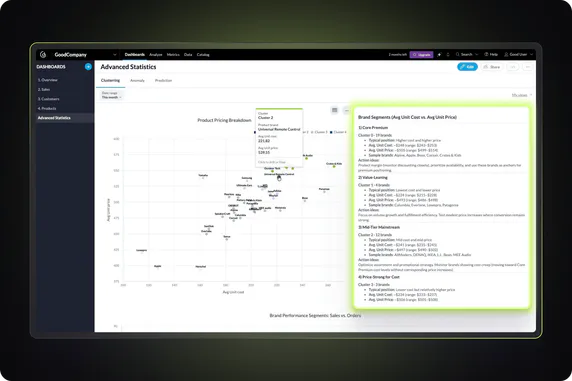
Analytics tools are everywhere, but most were never built to turn data into timely, reliable, and repeatable decisions at scale. Decision intelligence platforms exist to close that gap, embedding data, AI, and business logic directly into the decision workflow. This article covers how they differ from general-purpose analytics software, and which specific capabilities to look for when evaluating one.
If you're new to decision intelligence, see our complete guide for a full overview of how it works, including its three levels and how to build a framework.
Key Takeaways
- The best decision intelligence solutions combine AI, a governed semantic layer, self-service analytics, real-time processing, and embedded decision automation in a single coherent system.
- Data governance and explainability are not optional extras. In enterprise environments, they are structural requirements that determine whether a platform can be trusted, audited, and scaled.
- Architecture matters as much as features. Composable, API-first platforms embed into existing workflows rather than forcing users into a separate tool, which is where adoption breaks down.
- GoodData is one of the few platforms that unifies agentic AI, a governed semantic layer, embedded analytics, and multi-tenant scalability in a single stack, removing the need to integrate multiple separate tools.
What Is a Decision Intelligence Platform?
A decision intelligence platform helps organizations make better decisions, faster, by combining data, AI, and business logic in one place. Think of it less like a reporting tool and more like a system that takes your data and turns it into a clear next step.
Most analytics tools stop at the insight; they show you a chart, surface a trend, or flag an anomaly, and then leave the decision entirely to you. A decision intelligence platform is designed to guide action, not just inform it, which is a fundamentally different job.
Decision intelligence software is used across a wide range of roles and industries: CIOs evaluating enterprise infrastructure, product teams building analytics into customer-facing tools, and day-to-day decision-makers in finance, retail, supply chain, and contact centers who need reliable guidance inside the tools they already use.
What Capabilities Should You Look for in a Decision Intelligence Platform?
Not all decision intelligence platforms are built equally. Some are genuine end-to-end solutions, others are familiar BI tools with AI features added on top. The difference matters, especially when you are making an enterprise purchasing decision that will shape how your organization acts on data for years to come.
The following features separate a real decision intelligence platform from the rest:
1. A Governed Semantic Layer
A semantic layer is a translation layer that sits between your raw data and the business logic used in reports, dashboards, AI outputs, and analytics agents. It is where technical data gets converted into terms and metrics that the rest of the organization actually understands and uses.
Without a semantic layer, different teams end up working from different definitions of the same number. One team's "revenue" includes returns, another's does not. Those inconsistencies quietly undermine decision quality across the business and are one of the most common reasons decision intelligence programs fail to deliver.
Gartner predicts that universal semantic layers will soon be treated as critical infrastructure, as they are the only way to improve accuracy, manage costs, and stop costly inconsistencies before they spread.
When evaluating a data intelligence platform, look for:
- A single, governed definition of every metric and KPI.
- Inherited permissions that cascade across workspaces automatically.
- Version control for business logic and data models.
- Support for business terminology and synonyms, so users can query in natural language.
How the Semantic Layer Functions in GoodData
GoodData’s AI Lake functions as a governed, self-learning semantic layer that unifies structured and unstructured data. Business logic is defined once and inherited automatically across dashboards, agents, and embedded workflows, so every team is always working from the same source of truth.
2. AI and Agentic Analytics Capabilities
In the best decision intelligence platforms, AI is a core architectural layer that runs through every part of the system, from how data is queried to how decisions are executed and monitored.
A platform worth evaluating should support three distinct tiers of AI capability:
- AI assistants: Conversational, context-aware querying that lets non-technical users ask questions in plain language and receive governed, traceable answers without writing a single line of code.
- AI agents: Autonomous agents that execute multi-step analytical workflows, monitor outcomes, and surface recommendations without constant human input.
- AI automation: Fully governed decision flows that execute within predefined parameters and generate auditable decision trails, removing humans from routine decisions entirely where appropriate.
Beyond these three tiers, two additional capabilities are non-negotiable:
Explainable AI (XAI) ensures every output can be traced back to its data source and decision logic. In regulated industries like insurance, black-box AI is not an option. Look for platforms that show confidence levels, contributing factors, and alternative options alongside every recommendation.
Decision orchestration gives organizations the ability to compose, sequence, and govern decision workflows across agents, human reviewers, and automated actions, keeping complex processes coordinated and auditable end to end.
GoodData’s Agentic and AI Capabilities
GoodData's Agent Builder and AI Automation tools allow organizations to build context-aware agents that reason over governed data, execute workflows, and surface explainable recommendations. The AI Assistant provides governed, conversational access to data for all user types.
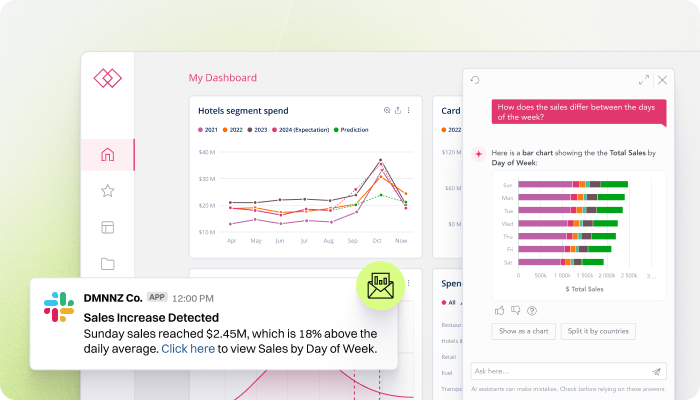
GoodData’s AI Assistant
3. Real-Time Data Integration and Processing
Decision intelligence is only as current as the data it runs on. A platform that relies on batch-updated data is delivering yesterday's insight to today's decision, which defeats the purpose of having a decision intelligence system in the first place.
When evaluating a platform, look for:
- Support for real-time and streaming data alongside traditional batch ingestion, including big data sources at scale.
- Native connectors to major cloud data warehouses, including Snowflake, BigQuery, and Redshift.
- A flexible connection layer that can handle custom data sources, APIs, and ML model outputs.
- High-performance query processing with built-in caching and query acceleration, so analytics stay fast even across large, complex datasets.
That last point matters more than it might seem. Real-time data integration is only useful if the platform can query it quickly. Slow query performance at scale turns a real-time data advantage into a bottleneck.
Data Integration and Processing at GoodData
GoodData's FlexConnect allows organizations to connect to virtually any data source, including APIs and ML models, using an open, flexible protocol. For organizations with complex or non-standard data architectures, this is a meaningful differentiator that removes the need to restructure existing data infrastructure before getting value from the platform.
4. Embedded Analytics and Multi-Tenant Architecture
A decision intelligence platform should deliver insights where decisions actually happen: inside the products, portals, and workflows people already use. Asking users to switch to a separate analytics tool adds friction, and friction is where adoption dies.
When evaluating a platform, look for:
- Embedding options via React SDK, Web Components, or iFrame.
- White-labeling capabilities and full UX customization to match your brand or product.
- Multi-tenant architecture that isolates each customer or business unit in its own environment, with its own permissions, data access, and branding.
Multitenancy is particularly important for software companies, contact centers, and enterprises serving multiple customers or business units simultaneously. Without it, scaling analytics across tenants requires significant platform-level re-engineering every time you add a new customer or division.
Embedded Analytics and Multitenancy at GoodData
GoodData is built for embedded analytics at scale. Its native multi-tenant architecture allows organizations to deploy fully isolated, governed analytics environments for each customer or business unit, without rebuilding the platform each time.
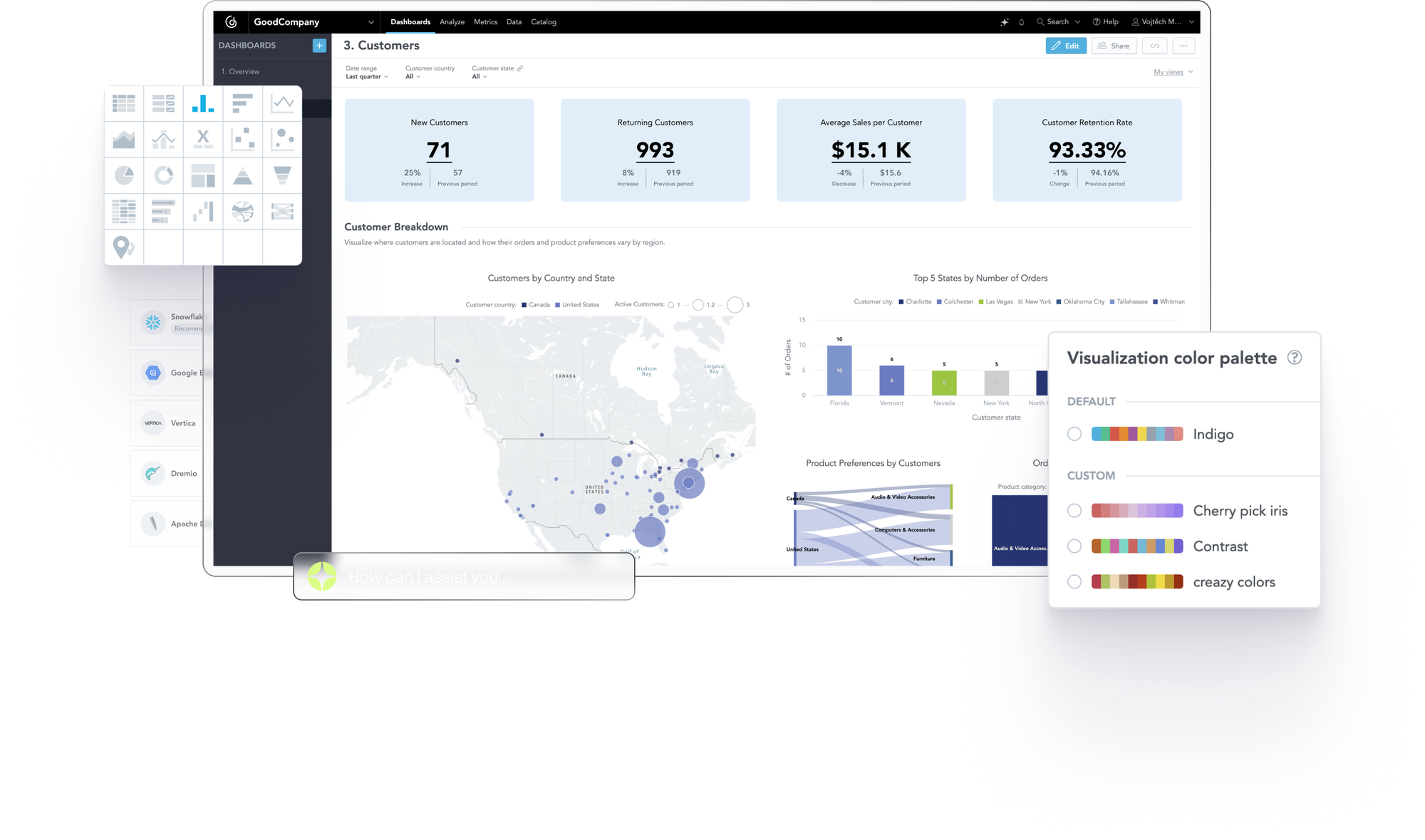
The best data intelligence software allows you to embed analytics into any application or product
5. Self-Service Analytics for Business Users
A decision intelligence platform should not require data science expertise to deliver value. Business users across finance, retail, supply chain, contact centers, and HR need to be able to build dashboards, ask questions, and explore data without depending on a BI team to do it for them.
When evaluating a platform, look for:
- An intuitive drag-and-drop dashboard builder that requires no technical knowledge.
- Natural language querying via an AI assistant, so users can ask questions in plain English.
- Pre-built visualizations that can be deployed quickly without custom development.
- The ability to generate ad-hoc insight without writing code.
This matters beyond convenience. If only data teams can access the platform, decision intelligence stays at the analytical layer and never reaches the operational decision-makers it is meant to serve. Self-service is what makes the platform useful to the whole organization.
Self-Service Analytics at GoodData
GoodData provides an AI Assistant that enables natural language querying across governed data. Smart Search and the AI Chat interface let users ask plain-English questions and receive chart-level answers grounded in the semantic layer, with no SQL required.
6. Data Governance, Security, and Compliance
In regulated industries like healthcare, every decision a platform supports or automates must be fully traceable and auditable. McKinsey has found that only around one-third of organizations have reached maturity level three or higher in governance and agentic AI controls, making structural governance one of the clearest differentiators between enterprise-ready platforms and the rest.
When evaluating a platform, look for:
- Role-based access control with inherited permissions that cascade across workspaces.
- End-to-end audit trails for every AI recommendation and automated decision.
- Compliance certifications: SOC 2 Type II, ISO 27001, GDPR, and HIPAA.
- Flexible deployment options to meet data residency requirements: cloud, self-hosted, or multi-region.
That last point is increasingly important for global enterprises. Data residency regulations vary by region, and a platform that can only operate in a single cloud environment will create compliance problems as you scale.
Governance and Security at GoodData
GoodData's governance architecture ensures every agent and AI output is grounded in a traceable, auditable decision path. Certified analytics and cascading permission management mean governance scales without adding administrative overhead. GoodData supports deployment across multiple regions, with a self-hosted option available for organizations with strict data residency requirements.
7. Context Management
Context management is what separates a decision intelligence platform from a generic AI tool. It is the capability that ensures AI agents and assistants understand not just the numbers in front of them, but also the business environment in which those numbers exist.
Without it, an AI assistant can produce technically accurate outputs that lead to entirely wrong decisions. A metric that looks like a problem in isolation might be perfectly normal given seasonal trends, regional variation, or a recent product launch. Context is what connects raw data to real-world meaning.
A platform with strong context management should bring together:
- Structured data: metrics, KPIs, and dashboards.
- Unstructured content: documents, PDFs, and business notes.
- Business logic: definitions, formulas, hierarchies, and synonyms.
All of this should feed into a single governed analytical context that AI agents can draw on automatically, without requiring manual configuration for every new workflow or use case.
Context Management at GoodData
GoodData's Context Management provides a governed contextual layer that brings together semantic modeling, data governance, knowledge grounding, and full observability in one place. Business logic is defined once and shared across assistants, agents, dashboards, and embedded applications, so AI outputs stay consistent regardless of how a question is asked. Every response is traceable back to its source, making AI behavior transparent and auditable in production environments.
8. Analytics as Code and Developer Tooling
Enterprise-scale decision intelligence requires the ability to manage analytics assets the same way software engineers manage code (with version control, automated deployment, and programmatic control). Analytics as Code makes this possible by treating dashboards, metrics, and data models as code that can be versioned, tested, and deployed through standard CI/CD workflows.
For organizations deploying decision intelligence across many tenants or business units, this is not optional. Manual management of analytics assets at scale is simply not feasible.
When evaluating a platform, look for:
- Declarative SDKs and open APIs for programmatic control of analytics assets.
- CLI tooling and IDE extensions for developer workflows.
- Git-based version control for dashboards, metrics, and data models.
- MCP (Model Context Protocol) server support, which enables AI agents to interact with analytics capabilities programmatically.
That last point is increasingly important as agentic AI becomes a core part of decision intelligence architecture. A platform without MCP support will struggle to integrate with the next generation of AI tooling.
Analytics as Code at GoodData
GoodData's platform is built API-first, with the entire analytics layer accessible programmatically. The Python SDK and VS Code Extension allow data engineers to define, version, and deploy dashboards, metrics, and semantic models as code, using standard CI/CD pipelines and Git workflows. The MCP Server goes further, enabling AI agents to connect directly to the platform and execute analytics end to end, from building metrics to updating dashboards, without manual intervention at every step. All of this runs within the same governance and permissions model used by human teams.
9. Data Visualization and Reporting
Visualization is where decision intelligence becomes legible. It is the point at which all of the data processing, AI reasoning, and business logic behind a platform surfaces as something a human can actually read, interpret, and act on.
The distinction worth making here is between passive reporting and active, AI-annotated dashboards. A static chart shows you a number, while an intelligent dashboard explains why that number changed, flags what is unusual, and draws attention to what actually requires a decision. That difference matters far more than chart variety or design options.
When evaluating a platform, look for:
- AI-infused dashboards that explain metric changes, not just display them.
- Anomaly detection and trend highlighting built into the visualization layer.
- Interactive charts with drill-through capability, from summary to detail.
- Customizable widgets that can be tailored to different user roles and contexts.
The goal is dashboards that do part of the analytical work for the person looking at them, so less time is spent interpreting data and more time is spent acting on it.
Data Visualization at GoodData
GoodData delivers AI-infused dashboards that go beyond static reporting. Built-in AI features explain metric changes, identify top performers and underperforming areas, and surface unexpected shifts automatically, turning dashboards from information displays into active decision-support tools.
Decision Intelligence Platform Capabilities at a Glance
The table below can be used as a quick reference when evaluating decision intelligence platforms. It maps each core capability to what it does and why it matters. GoodData is used as an example of how these capabilities can be delivered in practice.
| Capability | What It Does | Why It Matters for Decision Intelligence | How GoodData Delivers it |
|---|---|---|---|
| Governed Semantic Layer | Centralizes and governs metric definitions across the organization. | Ensures consistent data across all decisions and AI outputs. | AI Lake: governed, self-learning semantic layer. |
| Agentic AI and AI Automation | Builds and deploys autonomous agents that execute analytical workflows. | Powers decision automation and orchestration at scale. | Agent Builder (AI Hub), AI Automation, AI Assistant. |
| Explainable AI (XAI) | Makes every AI recommendation traceable and interpretable. | Builds stakeholder trust and meets compliance requirements. | Auditable, traceable decision paths built into all agents. |
| Real-Time Data Integration | Connects to live data sources including APIs and ML models. | Ensures decisions are based on current, not historical, data. | FlexConnect, native cloud warehouse connectors. |
| Embedded Analytics | Delivers intelligence inside existing products and workflows. | Removes friction between insight and decision. | React SDK, Web Components, iFrame, white-label support. |
| Multi-Tenant Architecture | Isolates environments per customer or business unit. | Enables enterprise and SaaS-scale deployment. | Native multi-tenancy with workspace-level governance. |
| Self-Service Analytics | Enables non-technical users to query and explore data. | Extends decision intelligence beyond the BI team. | AI Assistant, Smart Search, drag-and-drop dashboards. |
| Governance and Security | Provides role-based access, audit trails, and compliance certifications. | Required for regulated industries and enterprise governance. | SOC 2 Type II, ISO 27001, GDPR, HIPAA; inherited permissions. |
| Context Management | Grounds AI in business logic, not just raw data. | Prevents hallucinations and misaligned recommendations. | Context Management: unified analytical context for all agents. |
| Analytics as Code | Manages analytics assets programmatically via SDKs and APIs. | Enables CI/CD, version control, and scalable deployment. | Python SDK, React SDK, declarative APIs, MCP Server. |
| Data Visualization | Displays AI-annotated insights in accessible, interactive formats. | Makes data legible to decision-makers at all levels. | AI-infused dashboards with anomaly detection and trend explanation. |
Which Decision Intelligence Platform Capabilities Matter Most by Industry?
Not all decision intelligence capabilities carry equal weight across industries. A bank and a retailer both need real-time data integration, but their priorities diverge sharply after that.
Knowing which capabilities are non-negotiable for your context is what turns a feature comparison into a genuine platform evaluation.
The table below maps the four most common deployment contexts to their highest-priority capabilities.
| Industry | Top Capability Priorities | Why |
|---|---|---|
| Financial services and banks | Explainable AI, data governance, audit trails, compliance certifications (SOC 2, ISO 27001, GDPR). | Every automated or augmented decision must be traceable and defensible under regulatory scrutiny. |
| Retail and e-commerce | Real-time data integration, self-service analytics, embedded analytics. | Pricing, inventory, and promotional decisions need to happen at speed, across non-technical teams, inside existing tools. |
| Supply chain and operations | Real-time processing, agentic automation, ERP and operational system integration. | High-volume, time-sensitive decisions across complex supplier and logistics networks demand autonomous execution within governed parameters. |
| Contact centers and customer support | Embedded analytics, multi-tenancy, AI-assisted decision support, context management. | Decision intelligence needs to surface inside the platforms agents and managers already use, in real time, without requiring a context switch to a separate analytics tool. |
For full industry use case examples, including how decision intelligence is applied in banking, healthcare, retail, supply chain, marketing, and HR, see our complete guide to decision intelligence.
How to Choose the Right Decision Intelligence Company
There are many decision intelligence vendors on the market, and most will claim to do everything. These are the questions worth asking before you commit.
- Does the solution have a genuine semantic layer, or is it reporting with AI features attached? This is the single most important structural question. Without a governed semantic layer, consistency across decisions cannot be guaranteed.
- Can it embed into your existing products and workflows? A platform that requires users to context-switch to a separate tool will struggle with adoption. Decision intelligence needs to surface where decisions actually happen.
- Is explainability built into the AI architecture, or added on top? In regulated industries, this is non-negotiable. If the vendor cannot clearly show how every AI output is traced back to its data source and decision logic, that is a red flag.
- How does it handle governance at scale? Across multiple tenants, business units, or regulated environments, governance needs to be structural, not manual. Ask specifically how permissions, audit trails, and compliance certifications are managed.
- Does the vendor have a track record in your industry? Experience in finance, retail, supply chain, or contact centers matters. Industry-specific decisions have industry-specific constraints.
- What does the deployment model look like? SaaS, self-hosted, and multi-region options each carry different implications for data residency and compliance. Make sure the vendor can meet your requirements before the contract conversation begins.
- What developer tooling is available? For enterprise deployments, programmatic management at scale is essential. Look for open APIs, SDKs, and MCP server support.
Why GoodData Is a Leading Enterprise Decision Intelligence Solution
GoodData is one of the few platforms that delivers the full decision intelligence stack in a single system: governed semantic layer, agentic AI, embedded analytics, multitenancy, context management, and developer tooling. This means there is no need to stitch together separate tools to get from data to decision.
Ready to see what a data-driven decision intelligence platform looks like in practice? Get a demo.
Frequently Asked Questions About Decision Intelligence Platforms
Traditional analytics tools display historical data in reports and dashboards. Decision intelligence software is built to drive action, combining AI, business logic, and automation to move from insight to decision. The key difference is purpose: one informs, the other acts.
They connect to live data sources, process information as it arrives, and surface recommendations within the workflows where decisions happen. This removes the delay between data becoming available and a decision being made, which is critical in fast-moving environments like retail, finance, and supply chain.
Ask whether the platform has a genuine semantic layer, how explainability is built into the AI architecture, what compliance certifications it holds, and whether it can embed into your existing tools. Deployment model and data residency support are also worth confirming early.
Yes. Enterprise-grade platforms include multi-tenant architecture, role-based access control, audit trails, compliance certifications, and programmatic management via APIs and SDKs. These are structural requirements for large organizations, not optional add-ons.
BI vendors build tools for reporting and data exploration. Decision intelligence companies build systems designed to automate, augment, and govern the decisions that follow from that data. The architecture, AI integration, and governance model are fundamentally different.
The best platform for a large organization is one that combines a governed semantic layer, agentic AI, embedded analytics, and enterprise-grade governance in a single stack, without requiring separate tools to be integrated. Scalability, multitenancy, and deployment flexibility are also key criteria at enterprise scale.
Yes. The best platforms are designed to connect to existing data warehouses, cloud platforms, and operational systems without requiring significant re-engineering. Look for native connectors to major cloud data warehouses and a flexible integration layer that can handle custom or non-standard data sources.