AI Observability Tools: Do You Need a Separate One, or Is It Already in Your Platform?
5 min read | Published


Search for "AI observability tools" or "AI observability platform" and most results are the same thing: a listicle ranking 10 to 20 vendors, sorted by feature checklist. None of them ask the question that actually matters first, which is whether you need a new tool or platform at all. This guide skips the ranking and gives you a decision framework: when a dedicated AI observability tool earns its place, when the platform you already run AI on is enough, and what adding another tool actually costs beyond the license fee.
For the broader picture of what AI observability covers, see What Is AI Observability? A Practical Guide. For the specific case of AI agents, see AI Agent Observability.
Key Takeaways
- "AI observability tools" usually means one of three categories: LLM tracing, agent monitoring, or evaluation platforms, and most vendors specialize in one.
- Dedicated tools become more valuable when you need deep application tracing, structured evaluation, or cross-model/cross-platform observability that your existing platform does not provide.
- Built-in AI usage visibility is often enough when your AI features already run inside an analytics or BI platform that has the underlying data.
- Every additional observability tool adds authentication, telemetry integration, data-governance considerations, and another interface or workflow to manage.
- AI services frequently use consumption-based pricing, so tool sprawl can create additional cost-management challenges.
What "AI Observability Tools" Usually Means
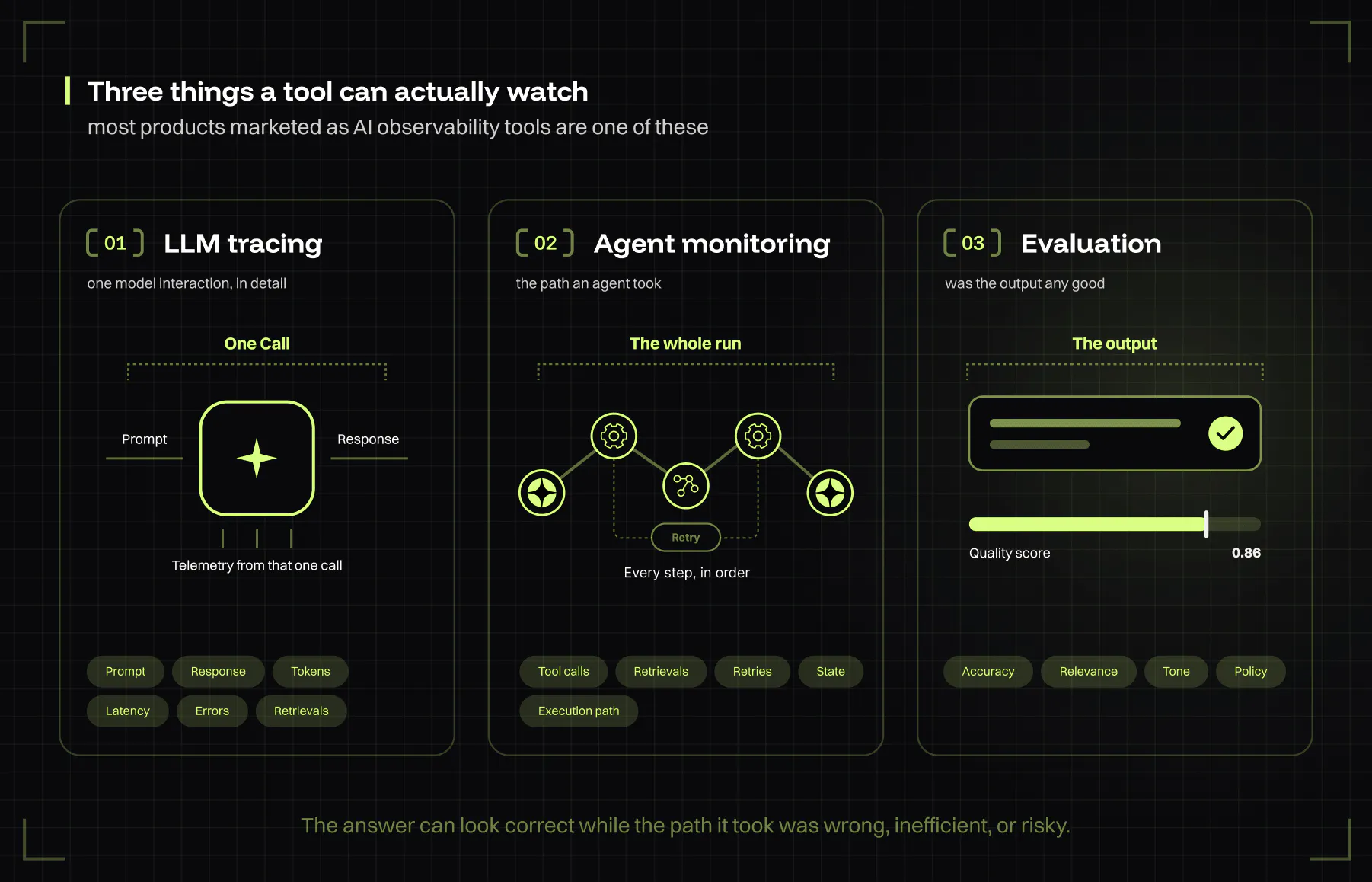
Most products marketed as "AI observability tools" fall into one of three categories, and knowing which one you actually need narrows the search considerably.
LLM tracing tools capture telemetry around model interactions, including prompts and responses when enabled, tokens, latency, errors, retrievals, and increasingly tool and agent activity. This is the category most open-source and developer-first tools target, and it is the right starting point if your problem is understanding what a single LLM call did.
Agent monitoring tools capture tool calls, model invocations, retrievals, retries, state transitions, and the execution path an agent took. This category is newer and less consolidated than LLM tracing, since agent-specific tracing standards are still being defined.
Evaluation platforms score output quality against a standard, whether through automated scoring models, human review workflows, or structured feedback collection. Some tools combine this with tracing; others are evaluation-only and expect you to bring your own trace data.
A single vendor rarely does all three well. Before comparing tools, it is worth being specific about which of these three problems you are actually trying to solve, since a tool built primarily for LLM tracing will not give you strong agent-behavior visibility, and vice versa. Many products marketed broadly as "AI monitoring tools" lean toward one category without saying so upfront, which is part of why the listicle format makes comparison harder, not easier.
When You Actually Need a Dedicated Tool
A dedicated AI observability tool earns its place clearly in a few specific situations.
You are building custom LLM applications outside any existing platform. If your team is writing LLM application code directly, with no analytics or BI platform underneath that already has usage and workspace context, a dedicated tool is filling a real gap rather than duplicating existing visibility.
You need deep, model-level tracing across a multi-vendor LLM stack. Teams routing between multiple model providers, or comparing model performance head to head, need tracing built specifically for that comparison, which most general platforms do not provide.
Evaluation is a core part of your development workflow. If your team runs structured evaluations before every deployment, a dedicated evaluation platform with versioning, regression testing, and scoring history is likely to outperform a bolt-on feature inside a broader platform.
You are past the pilot stage with agents taking real actions. Once agents update records or trigger workflows in production, the debugging depth a dedicated agent observability tool provides often justifies the added complexity of running one.
When Built-In AI Usage Visibility Is Enough
The opposite case is at least as common, and it is the one most listicles skip entirely.
Your AI features already run inside an analytics or BI platform. If agents, AI assistants, or AI-powered features are already part of a platform you use for other purposes, that platform may already have useful context such as user identity, workspace, permissions, and semantic-model information. The next question is whether it also collects and exposes AI-specific telemetry.
Your primary need is adoption, usage, and cost visibility, not deep model-level tracing. Most organizations' first AI observability question is "who is using this and what does it cost," not "show me the complete execution trace for every interaction." If that describes your situation, a dedicated tracing tool solves a problem you do not have yet.
You want to avoid managing another vendor relationship, another login, and another dashboard. This is a real cost, not just an inconvenience; see the section below on what tool sprawl actually costs.
You are early enough that instrumentation overhead outweighs the value. Dedicated observability tools generally require SDK integration and configuration. If your AI usage is still small and concentrated, built-in AI usage visibility may answer your questions without that setup cost.
A Simple Decision Framework
| Your situation | Likely answer |
|---|---|
| Building custom LLM apps outside any platform | Dedicated tool |
| AI features already run inside an analytics/BI platform | Check what that platform surfaces first |
| Need is mainly adoption, usage, and cost visibility | Built-in AI usage visibility is often enough |
| Needs Deep multi-step agent debugging | Deep execution tracing required; compare built-in vs dedicated tooling |
| Running evaluations as a core development workflow | Dedicated evaluation platform |
| Comparing performance across multiple model providers | Dedicated LLM tracing tool |
The pattern across every "dedicated tool" row is the same: the need is specific and deep, and no existing system already has the context to answer it. The pattern across the "built-in is often enough" row is also the same: the need is usage-level, and a platform you already run AI inside likely already has the underlying data.
Discover how GoodData.AI helps you build, govern, and scale analytics, AI, and agents from one platform.
Request a demo
The Cost of Adding Another Tool
Every additional observability tool has costs that show up before the license fee does. It is another system to authenticate against, another place where data has to be replicated or kept in sync, and another dashboard that someone on the team has to remember to check. None of that shows up in a vendor comparison table, but all of it shows up in how much value the tool actually delivers.
This is not a hypothetical concern. Consumption-based pricing, the same model most AI tools use, is specifically called out as a factor that undermines cost management when tools proliferate outside clear ownership, according to a 2025 SaaS benchmark analysis of shadow AI and SaaS sprawl (Torii, 2025 SaaS Benchmark Report). A tool added to solve one visibility gap can quietly become a second cost-visibility problem if nobody owns tracking what it costs.
None of this is an argument against dedicated tools in the cases where they are the right call. It is an argument for checking what you already have before adding one, since the real cost of a new tool is higher than its list price.
How GoodData.AI Approaches This Today
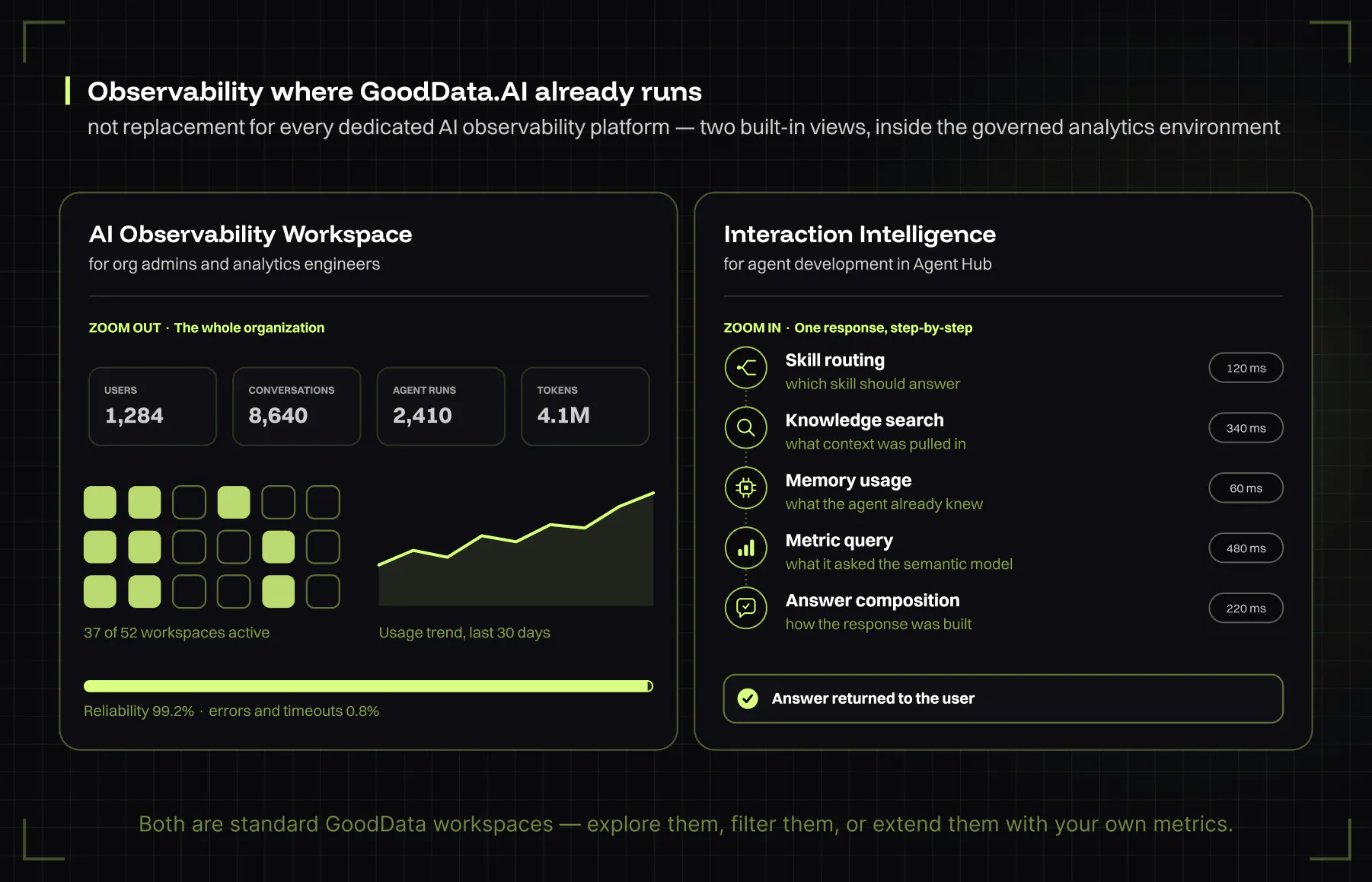
GoodData.AI is not positioned as a replacement for every dedicated AI observability platform. Instead, GoodData.AI observability provides observability wherever a team already works, whether that's the internal analytics they use daily, an external system, or another interface built into the platform's open architecture.
Because agents, assistants, and analytics all run on the same governed platform, adoption, usage, reliability, and cost data are already there rather than requiring a separate tool to collect them. Teams can explore this through the reporting they already use, or extend it with their own metrics, instead of learning a new system just to see how AI is being used.
Where to Go From Here
The right question is not "which AI observability tool is best." It is "what does my situation actually need, and do I already have it." Building custom LLM applications outside any platform, running structured evaluations, or debugging production agents in depth are real reasons to add a dedicated tool. Needing to know who's using AI, where, and what it costs often is not, if that visibility already exists somewhere your AI runs.
For the broader concepts behind AI observability and how agent behavior tracing works, see What Is AI Observability? and AI Agent Observability. For how AI usage visibility connects to governance and compliance frameworks, see AI Governance Starts with Knowing Who's Using AI.
If you've worked through the framework above and landed on "built-in is likely enough," see how GoodData.AI's agentic analytics platform surfaces AI usage out of the box, or request a demo to see it in action.
Discover how GoodData.AI helps you build, govern, and scale analytics, AI, and agents from one platform.
Request a demo
Frequently Asked Questions
LLM tracing tools (individual model calls, prompts, tokens, latency), agent monitoring tools (multi-step agent behavior and tool calls), and evaluation platforms (output quality scoring). Most vendors specialize in one category rather than covering all three well.
Not automatically. Check what your existing platform already surfaces about AI usage, workspace context, and cost before adding a separate tool. Dedicated tools make the most sense when your existing platform does not provide the tracing, evaluation, model comparison, or cross-system visibility you need.
Beyond the license fee: authentication overhead, data that has to be replicated or synced, and an additional dashboard someone has to check regularly. These costs exist regardless of whether the tool is the right choice, which is why checking existing visibility first matters.
When you're comparing performance across multiple model providers, need detailed prompt-and-completion-level tracing, or are building LLM applications with no existing platform that already has usage context.
For different questions, not the same one. Built-in usage analytics typically answers adoption, usage, and cost questions well. Deep model-level tracing, multi-step agent debugging, and structured evaluation workflows usually require purpose-built tooling.
Start with the specific question you're trying to answer. "Who's using AI and what does it cost" points toward usage analytics. "What did this agent do at each step" points toward agent monitoring. "Is this output good" points toward an evaluation platform.