What Is AI Observability? A Practical Guide
9 min read | Published


Most AI systems fail quietly. A chatbot gives a wrong answer, an agent picks the wrong tool, or a monthly AI bill triples, and nobody notices until a customer complains or finance asks questions. AI observability is the practice of tracking, measuring, and evaluating how AI systems actually behave in production: what they do, how well they perform, and what they cost, so these failures surface before they become incidents.
This guide covers what AI observability means, why it differs from traditional software monitoring, what to track first if you are starting from zero, and how the concept splits into three practical problems most teams eventually need to solve separately.
Key Takeaways
- AI observability tracks internal AI behavior, output quality, performance, and cost, not just whether a system is up or down.
- It differs from traditional software observability because AI systems are non-deterministic: the same input can produce different outputs.
- A mature practice rests on three pillars: traces (what happened), evaluations (how good was it), and metrics (how much did it cost and how fast was it).
- "AI observability" (observability for AI systems) is often confused with "AI-powered observability" (using AI to monitor infrastructure); they solve different problems.
- Start with adoption and usage data (who is using AI, where, how much) before investing in deeper tracing.
- Building AI agents is the easy part; proving they work correctly and trusting them enough to deploy widely is not, one reason as many as 88% of agent pilots never reach production.
What Is AI Observability?
AI observability is the ability to understand what an AI system did, how well it performed, and what it cost, based on the data it produces while running. It extends traditional observability, which tracks uptime, latency, and errors, into a domain where correctness and quality are not binary. The term covers generative AI observability and artificial intelligence observability more broadly, whether the system in question is a single LLM call, a multi-step agent, or a predictive model.
A traditional application either returns the right value or throws an error. An AI system can return a response that is technically successful (no error, normal latency) and still be wrong, irrelevant, or expensive. Standard uptime monitoring cannot catch that. AI observability closes that gap by adding categories of visibility that conventional monitoring does not cover.
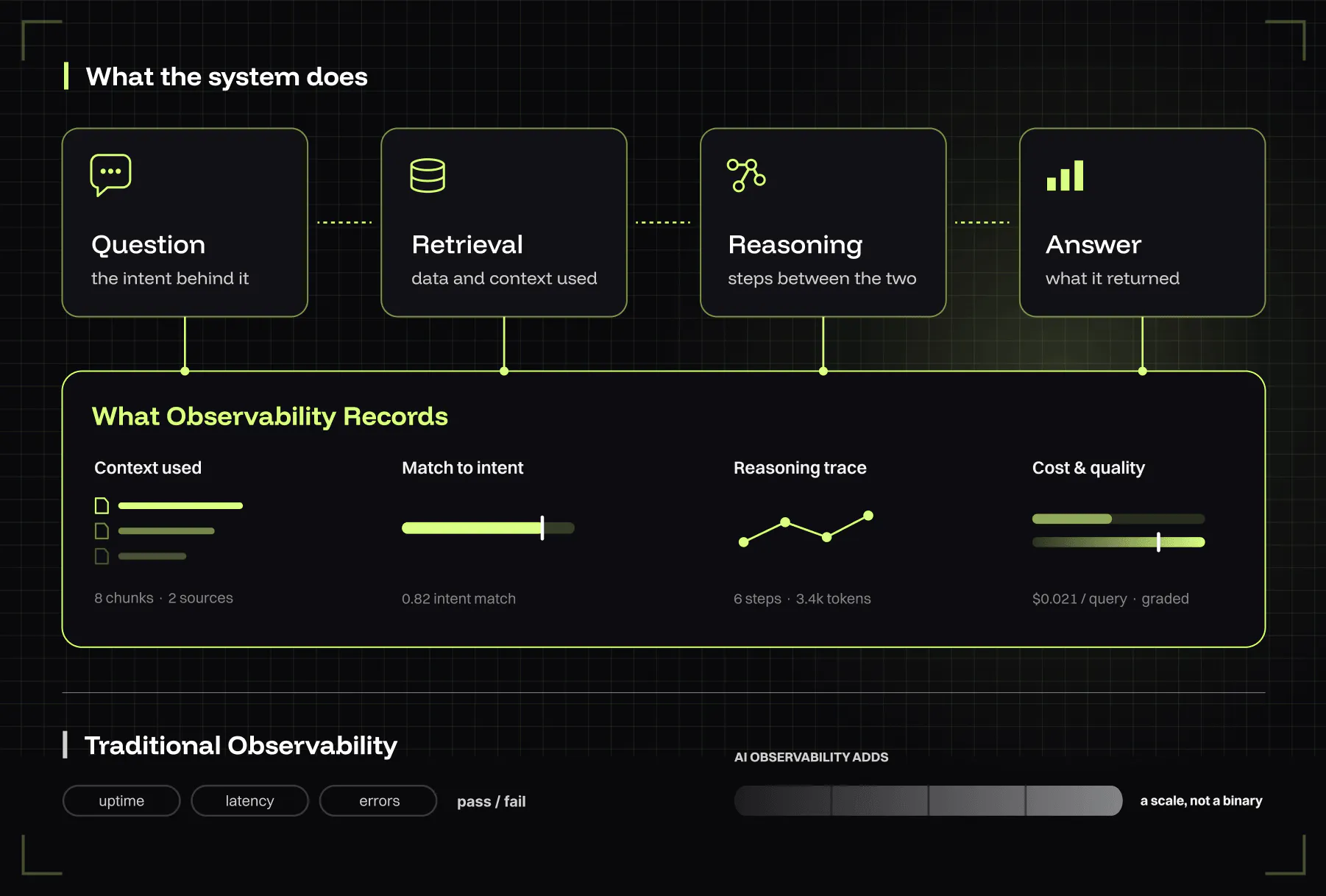
The Three Categories of Visibility AI Observability Adds
Behavior. What the system actually did internally, including reasoning steps, tool calls, and retrieved context, not just the final output. For an agent, this means knowing it searched a knowledge base, called a pricing API, then generated a summary, rather than just seeing the summary itself.
Quality. Whether the output was accurate, relevant, and useful, typically measured through evaluation scores or user feedback. Quality is not implied by the absence of an error; a fluent, confident, wrong answer produces no error at all.
Cost. How many tokens or queries a task consumed, and what that translates to financially. Because pricing is usage-based, cost scales with adoption in ways that are easy to lose track of without dedicated tracking.
How This Differs from Traditional APM
Traditional application performance monitoring (APM) answers a narrower set of questions: is the service up, how fast did it respond, did it throw an error. Those questions still matter, but they stop short of what actually determines whether an AI feature works: was the output any good, and did the system do the right thing to get there.
Why AI Observability Matters for LLMs and Agents
AI observability matters because AI systems fail in ways that traditional monitoring cannot detect, and because the stakes rise sharply once agents start taking autonomous actions rather than just generating text.
AI Systems Are Non-Deterministic
The same prompt sent to the same model can produce different outputs on different runs. This breaks a core assumption of traditional software testing and monitoring: that a given input reliably produces a given output. Without observability, a team cannot reproduce a reported issue without capturing the exact input, model version, and parameters used at the time of the failure.
This matters operationally. A support ticket that says "the AI gave me a wrong answer yesterday" is nearly impossible to debug without a trace of that specific interaction. Re-running the same prompt today may produce a correct answer and tell you nothing about what actually happened.
Agentic Workflows Raise the Stakes
An AI agent that plans, selects tools, and takes action on a user's behalf introduces failure modes a simple chatbot does not have. Gartner forecasts that 40% of enterprise applications will embed task-specific AI agents by the end of 2026, up from less than 5% in 2025 (Gartner, 2025). As agents move from answering questions to executing multi-step tasks, an unobserved failure can mean the wrong record gets updated or the wrong action gets taken, not just a wrong answer displayed on screen.
Observability Is the Leading Blocker to Production
Most organizations can already build AI agents. The harder problem is trusting them enough to deploy widely, because most teams cannot yet reliably prove the agents work correctly, or monitor and troubleshoot their behavior once they are in production. One estimate puts the cost of that gap at up to 88% of AI agent pilots never reaching production (Anaconda / Forrester, 2026, replicated by a16z and MIT Sloan).
Analyst-compiled research drawing on Gartner, McKinsey, IDC, and Forrester data backs this up at the enterprise level: evaluation and observability gaps are the single largest barrier enterprises face when moving AI agents from pilot to production, cited by 64% of leaders surveyed, and 70% name non-deterministic outputs specifically as their top production-readiness concern.
That combination, unpredictable behavior plus a limited ability to prove or monitor it, is why AI observability has become a prerequisite for scaling AI beyond pilots, not an optional add-on.
Discover how GoodData.AI helps you build, govern, and scale analytics, AI, and agents from one platform.
Request a demo
What Happens Without It
Consider a common scenario: an internal AI agent answers employee questions about expense reports. Over a few weeks, it starts giving inconsistent answers about the reimbursement limit for one expense category.
Without behavior tracing, quality signals, or usage data broken down by topic, the problem can go unnoticed until enough employees complain and someone manually reviews a sample of transcripts. With observability in place, the same drop in answer quality shows up as a quality-score dip tied to that topic days or weeks earlier, with the relevant interactions already logged for review.
AI Observability vs. AI-Powered Observability
These two terms sound similar but describe opposite things, and mixing them up leads teams to evaluate the wrong tools entirely.
AI observability means applying observability practices to AI systems: tracking what an LLM or agent does, how well it performs, and what it costs. The AI system is the thing being observed.
AI-powered observability means using AI to improve traditional infrastructure monitoring: anomaly detection, automated root cause analysis, or alert triage powered by machine learning, applied to conventional IT systems. Here, AI is the tool doing the observing, not the subject.
| AI Observability | AI-Powered Observability | |
|---|---|---|
| What's being observed | The AI system itself (LLMs, agents) | Traditional infrastructure (servers, apps, networks, logs) |
| Role of AI | The subject being watched | The tool doing the watching |
| Typical buyer | Data teams, AI/ML teams, product teams shipping AI features | Platform teams, SRE, IT operations |
| Example question answered | "Why did our support agent give an inconsistent answer?" | "Why did our Kubernetes cluster spike in latency?" |
| Example vendor category | LLM tracing and agent observability tools (Langfuse, Arize) | AIOps platforms (Dynatrace Davis AI, Splunk AI) |
A platform team monitoring Kubernetes clusters with AI-assisted anomaly detection is using AI-powered observability. A data team tracking why their customer-support agent gave an inconsistent answer is doing AI observability. The tooling, the buyers, and the skills involved are largely different, even though both fields borrow the word "observability."
When researching vendors or reading analyst reports, check which definition is in use. A tool built for AI-powered infrastructure monitoring will not help you trace what an LLM agent did during a failed task, and a tool built for LLM tracing will not replace your infrastructure monitoring stack.
Three Angles Worth Understanding
AI observability usually comes down to three practical questions: what is the agent doing, how is AI being used across the organization, and whether you need a separate observability tool at all.
Understanding Agent Behavior
Once an AI agent can call tools, retrieve data, and take multiple steps to complete a task, understanding what it did becomes just as important as understanding what it answered.
Tracing frameworks such as the OpenTelemetry GenAI Semantic Conventions help standardize this process. Tool calls, model invocations, and retrieval steps can be captured as traceable events, creating a record of how the agent executed a task (Greptime, 2026).
This is especially useful for debugging. When an agent produces the wrong result or takes the wrong action, the important question is not only what went wrong, but where it went wrong. Did it choose the wrong tool? Retrieve the wrong data? Fail during one particular step?
Without this visibility, teams are often left reproducing prompts and trying to guess what happened. For a deeper look at tracing standards and agent debugging, see AI Agent Observability.
Governance, Compliance, and Cost Visibility
As AI adoption grows, organizations also need visibility into how AI is being used: who is using it, in which environments or workspaces, how frequently, and at what cost.
This is often one of the first practical governance requirements enterprises encounter. Before addressing broader regulatory frameworks such as the EU AI Act or NIST AI Risk Management Framework, teams need a clear picture of AI activity across the organization.
Cost is part of that visibility. With usage-based AI pricing, one workspace, application, or user can account for a disproportionate amount of consumption. Without usage breakdowns, these patterns may only become visible when the overall bill increases.
For a deeper look at how usage visibility supports governance and cost control, see AI Governance Starts with Knowing Who's Using AI.
Do You Need a Separate Observability Tool?
Not every organization needs a dedicated AI observability platform.
If your AI agents or AI-powered features already run inside an existing analytics or application platform, it is worth checking what visibility that platform already provides before introducing another tool.
Dedicated observability products are particularly useful for teams building custom LLM applications across multiple models, tools, and services, where there is no single platform providing centralized visibility.
For teams whose AI capabilities already operate inside an analytics or BI platform, some of the required usage and interaction data may already exist. The key question is whether the platform exposes enough of it to support monitoring, troubleshooting, governance, and cost analysis.
For a broader decision framework, see AI Observability Tools: Do You Need a Separate One?
Who Needs AI Observability
Data and analytics leaders need AI observability to answer governance and budget questions: who is using AI, is it delivering value, and what does it cost across the organization. This is usually the first audience to ask for usage visibility, well before anyone asks for deep behavioral tracing, and they are the ones who decide which changes get prioritized based on what observability shows.
Data engineers and architects need it to debug and improve AI features directly: tracing why an agent failed, tuning prompts based on evaluation scores, and instrumenting new AI features so they are observable from day one rather than retrofitted later.
Product teams shipping AI-powered features need enough visibility to know whether a feature is actually being adopted and whether user feedback signals are trending up or down after a change. For this audience, adoption is the key observability signal: it shows whether a shipped feature is working and shapes what to change next.
An AI Observability Checklist to Get Started
Most teams do not need to instrument everything on day one. Start with the category that answers the most urgent question in your organization, then expand. These five categories cover what a mature AI observability practice tracks.
Adoption and usage. Who is using AI, in which workspaces or teams, and how often. This is usually the fastest category to stand up because it does not require deep instrumentation of the AI system itself, only visibility into who is triggering it. A reasonable first milestone: a single dashboard showing active users, active workspaces, and total AI actions over the current month.
Performance. How fast the AI responds, end to end. Latency affects both user experience and, for agentic workflows, how long a multi-step task takes to complete. Track this per interaction, not just as a system-wide average, since a single slow tool call can dominate an otherwise fast agent.
Output quality. Whether the AI's responses are accurate, relevant, and useful. Teams typically track this through automated evaluation scores, human review samples, or direct user feedback signals like thumbs up/down. A negative-feedback-rate metric, tracked over time and broken down by topic or agent, is usually the fastest way to spot a quality regression before it becomes a support escalation.
Agent behavior. What the system did internally to reach its answer: which tools it called, what data it retrieved, how many steps or iterations it took. This is what turns a failed task from a mystery into a fixable bug. This category typically requires the deepest instrumentation of the five, since it means capturing a full trace, not just an input/output pair.
Cost. Query and token costs, broken down by workspace, agent, or user. Token-based pricing means cost scales with usage in ways that are easy to lose track of without dedicated tracking. Even a coarse breakdown, cost per workspace per month, is enough to catch runaway usage before it becomes a budget surprise.
Most teams start with adoption and usage, since it answers the most immediate organizational question ("is anyone actually using this, and where"), and build toward the other four as AI usage matures from pilot to production.
How GoodData.AI Approaches AI Usage Visibility Today
GoodData.AI approaches AI usage visibility as part of the analytics environment itself rather than as a separate governance data pipeline.
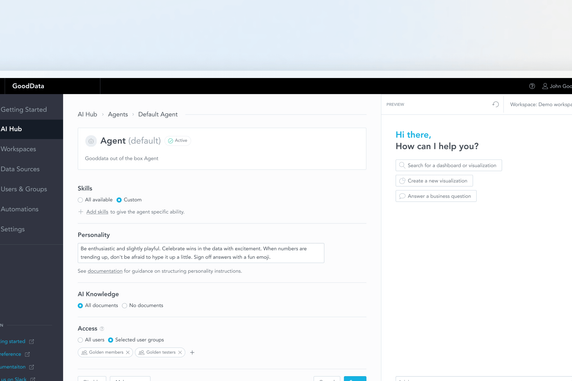
GoodData.AI Observability provides organization administrators and analytics engineers with a ready-made view of AI activity across their GoodData organization. It tracks adoption and usage across users and workspaces, conversations, agent activity, reliability, errors and timeouts, token consumption, and usage trends.
The observability data is collected automatically as users interact with GoodData AI features and is exposed through a standard GoodData workspace. Teams can therefore explore the managed dashboards, filter the data, or extend the provided analytics with their own metrics and visualizations.
This provides a useful operational foundation for AI governance: teams can see where AI is being adopted, which users and workspaces are generating activity, how different agents are being used, and where unusually high token consumption or reliability issues appear.
Where to Go From Here
AI observability is not a single tool decision. It is a practice built from three separate questions: how your agents actually behave, who is using AI and what it costs, and whether you need a dedicated tool or already have the visibility inside your existing platform. Most teams get further by answering these one at a time than by trying to instrument everything at once.
Start with the checklist above. Adoption and usage data alone answers the question most organizations ask first, and it is the fastest to put in place without new infrastructure.
If you're evaluating how to get this kind of visibility without adding a separate observability stack, see how GoodData.AI's agentic analytics platform surfaces AI usage out of the box, or request a demo to see it in action.
Discover how GoodData.AI helps you build, govern, and scale analytics, AI, and agents from one platform.
Request a demo
Frequently Asked Questions
MLOps monitoring typically tracks model performance metrics like accuracy drift or data drift for a trained model in production. AI observability is broader: it covers LLMs and agents that were not necessarily trained in-house, and adds behavioral tracing (what the system did) and cost tracking alongside quality metrics.
Not necessarily. If your AI features already run inside a platform that captures usage, performance, and cost data, check what that platform already surfaces before adding a separate tool. Dedicated tools make more sense for teams building custom LLM applications outside an existing platform.
At minimum: adoption and usage (who, where, how often), performance (response latency), output quality (accuracy and relevance), agent behavior (tool calls and reasoning steps), and cost (tokens and queries). Most teams start with adoption and usage and expand from there.
Usage visibility is typically the first practical step toward AI governance: knowing who uses AI and how much. It supports compliance work under frameworks like the EU AI Act or NIST's AI Risk Management Framework, but usage visibility alone does not constitute full compliance with any specific regulation.
LLM observability is a subset of AI observability focused specifically on large language model calls: prompts, completions, token usage, and latency at the model level. AI observability is the broader category that also includes agent behavior, multi-step workflows, and overall system-level usage and cost.
AI observability applies observability practices to AI systems (the AI is what's being watched). AI-powered observability uses AI to improve monitoring of traditional infrastructure (the AI is doing the watching). They address different problems and typically involve different tools.
Traces (a step-by-step record of what an AI system did during an interaction), evaluations (quality scores for the output), and metrics (aggregated numbers like latency, cost, and feedback rate tracked over time). Traces show what happened, evaluations show whether it was good, and metrics show the trend.
It varies, but data and analytics leaders typically own the governance and cost-visibility side, while data engineers or the team building the AI feature own behavioral tracing and quality evaluation. In smaller organizations, one team often owns all of it.